Ventilator Rapid Review
Ultra-fast guide for setting up and troubleshooting the ventilator — covering ~75% of common issues. Three topics:
NOTE
This is a rapid reference — not a comprehensive text. For detailed physiology and advanced modes, consult pulmonary references or the respiratory therapy team.
Setting Up the Vent
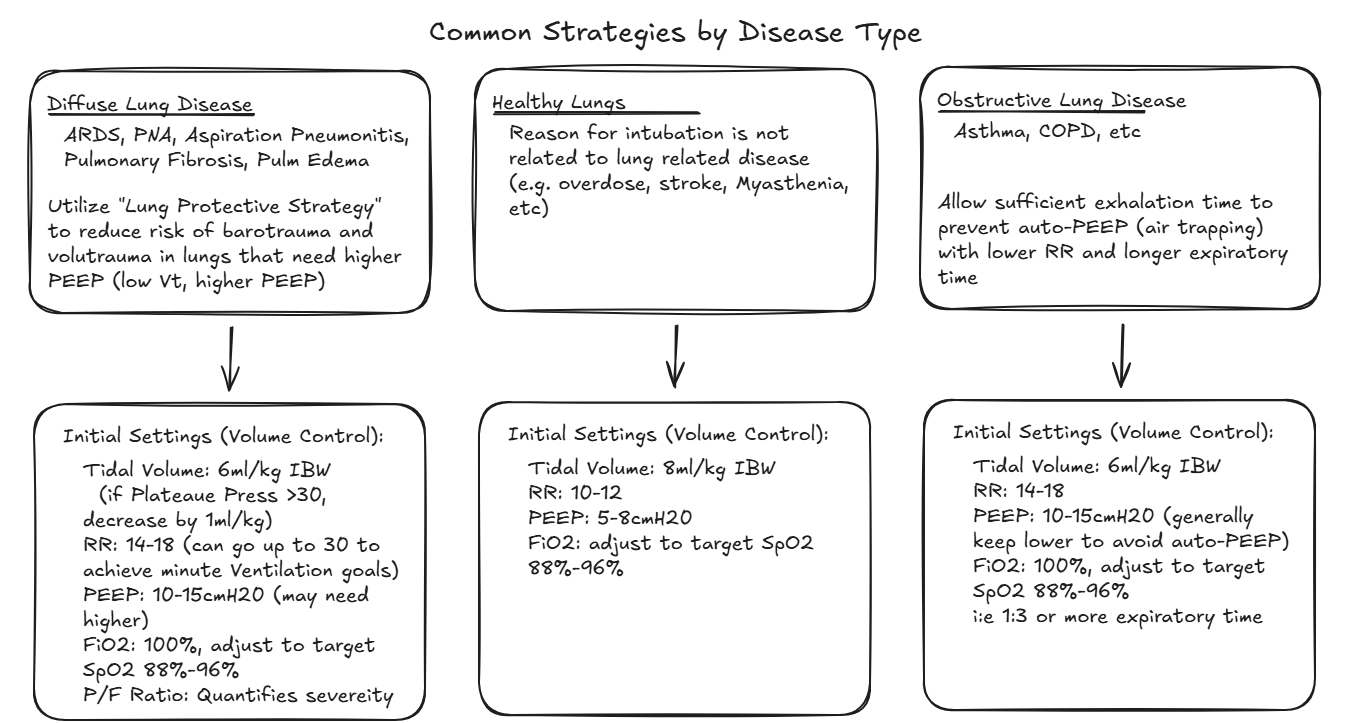
Initial Settings (Standard Adult)
| Parameter | Typical Starting Value |
|---|---|
| Tidal Volume (Vt) | 6–8 mL/kg ideal body weight (IBW) |
| Rate | 12–16 breaths/min |
| FiO₂ | 100% → wean to goal SpO₂ ≥ 92% |
| PEEP | 5 cm H₂O (start) |
| I:E Ratio | 1:2 |
Initial Settings Check
- Confirm ETT placement (CXR, EtCO₂, bilateral breath sounds)
- Set alarms: High pressure, low minute ventilation, apnea
- Check plateau pressure (goal < 30 cm H₂O) — hold inspiratory hold button
Vent Adjustments
Hypoxia (Low SpO₂)
| Problem | Intervention |
|---|---|
| Low SpO₂ | ↑ FiO₂ first, then ↑ PEEP |
| Refractory hypoxia | ↑ PEEP in increments of 2–3 cm H₂O; check plateau pressure |
| Unilateral lung issue | Consider proning, APRV mode, or RT consult |
WARNING
If plateau pressure > 30 cm H₂O, consider reducing tidal volume or PEEP. High plateau pressures = ventilator-induced lung injury (VILI) risk.
Hypercapnia (High CO₂ / Low pH)
| Problem | Intervention |
|---|---|
| High CO₂, pH okay | ↑ Rate (minute ventilation) |
| High CO₂, acidosis | ↑ Rate or ↑ Tidal Volume (check plateau) |
| Permissive hypercapnia | Accept pH ≥ 7.15–7.20 if plateau pressures are a concern |
Patient-Ventilator Dyssynchrony
| Pattern | Likely Cause | Fix |
|---|---|---|
| Flow starvation | Patient demands more than set flow | ↑ Peak flow or switch to PC mode |
| Double-triggering | Vt too low for demand | ↑ Vt or consider PC mode |
| Auto-PEEP / breath stacking | Insufficient expiratory time | ↓ Rate, ↑ I:E ratio (e.g. 1:3), check for secretions |
P/F Ratio for ARDS
Used to stratify ARDS severity and disease progression in place of the A-a gradient.
PaO₂ - From ABG
FiO₂ - From ventilator, HHFNC, or CPAP/BiPAP
| ARDS Severity | P/F Ratio | Considerations |
|---|---|---|
| Mild | 200 - 300 | Standard lung-protective ventilation (low Vt) |
| Moderate | 100 - 200 | Consider higher PEEP |
| Severe | < 100 | Consider proning and paralyizing |
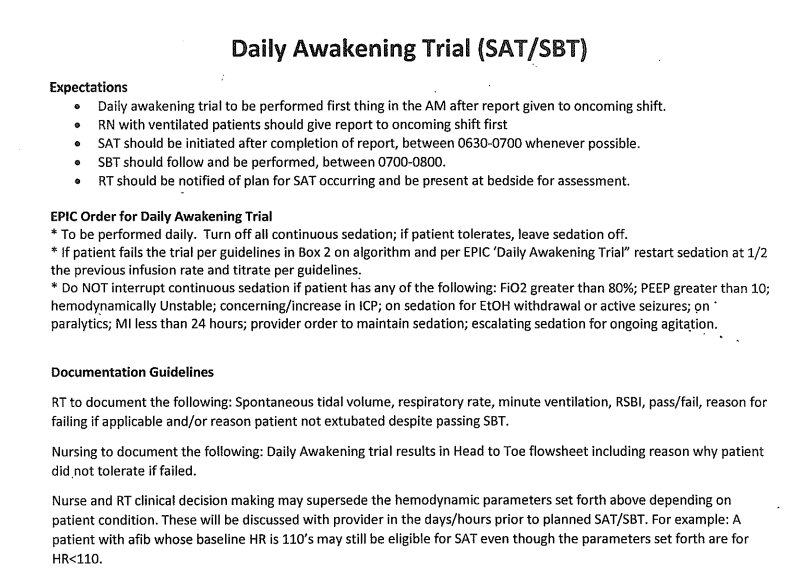
Weaning & SBT
TIP
SPH has an excellent SBT and weaning/extubation protocol already in place. See Extubation Readiness Assessment and existing extubation workflows.
Readiness Criteria
- Cause of respiratory failure resolving
- Hemodynamically stable (no/minimal vasopressors)
- Adequate oxygenation: PF Ration (PaO₂ / FiO₂) ≥ 150–200, PEEP ≤ 8
- Awake, following commands, intact airway reflexes
- No significant acidosis
SBT Settings
| Parameter | Value |
|---|---|
| Mode | PSV (Pressure Support Ventilation) or T-piece |
| PS | 5–8 cm H₂O (if PSV mode) |
| PEEP | 5-8 cm H₂O |
| Duration | 30–120 minutes |
Failure Criteria During SBT
- RR > 35
- SpO₂ < 88–90%
- HR > 140 or new arrhythmia
- SBP > 180 or < 80
- Agitation, diaphoresis, accessory muscle use
- PaCO₂ ↑ > 10 from baseline
Troubleshooting Quick Reference
| Alarm / Issue | First Action |
|---|---|
| High Pressure | Check for secretions/biting/kinked tube → suction → consider bronchodilator |
| Low Pressure / Low TV | Check circuit disconnection, leak, or cuff leak → re-secure airway |
| Apnea | Increase back-up rate or change mode |
| Auto-PEEP | Increase expiratory time → ↓ rate or I:E ratio |
Key Reference
- Full Excalidraw Diagram — interactive visual guide
- SBT Guide